Sunday, November 27, 2016

Electoral College a Sham?

After Trump won the election and became our president, (yes, even your president if you are a United States citizen) cries from the left have been shouting out loud ever since. What are they fighting against exactly? Democracy, practicality, and reality.


An imminent uproar followed when citizens discovered Trump not 
only won the electoral college but, apparently, lost the popular vote. Shortly after this current understanding, an article was published by the New York Times titled "The Electoral College Is Hated by Many. So Why Does It Endure?"

Writers of the article, Jonathan and Steve Eder go on to claim that the electoral college is "forever tipping (in favor to) rural/conservative/'white'/older voters". 

My response to that non-credible statement is puzzlement. Do the writers know how the electoral college works? When it comes to presidential elections, American citizens go out to vote every four years. The electoral college consists of 538 electors. Essentially, when voters go to the polls, they will choose which candidate receives their state’s electors. The candidate who receives a majority of electoral votes (270) wins the Presidency.


With this system, everyone gets a say in who ends up in the white house. The only way so-called "privileged" people could have an advantage over others is if they are voting and others are not. Another instance in which an advantage could be displayed is if the population of a state consists mainly of "privileged white folk". If this is the case that the journalists of the New York Times are referring to, how would this be considered an injustice? 

Hillary Clinton herself stated, “I believe strongly that in a democracy, we should respect the will of the people." Very well then, if the people out voting are made up of mostly conservatives, it only makes sense that our candidate is to come out a victor. It only makes sense that citizens exercising their voice in an election through voting are shown clearly in the election results. 

The seemingly ominous electoral college serves many practical purposes. It is in place to prevent the horror of constant recounts that would result in an election consisting of only the popular vote. It exists to prevent an overwhelming advantage to states with large populations. 


Imagine how simple it would be to rig an election if we only counted the popular vote. Warren Mass, a journalist for New American, wrote an article with indisputable proof that 3 million illegals voted in this 2016 election. Not only that; 4 million more people unknowing voted this year. They were not aware of this issue because they were dead!

With the electoral college we have in place, voter fraud such as this will not always count for enough to tip the scales in favor of a cheater in several states. However, the 7 million known cases of voter fraud this election could greatly influence the results in an election consisting of only the popular vote.

It is tragic that cheating has to be taken into account when considering the most practical form of democracy, however, it is still wise to consider that some candidates can and will do anything in order to get into office. 

Friday, November 11, 2016

Now What?

The world watched in complete awe the night of November 8th with the revealing of the United State's 45th president to come: Donald J. Trump. If I am to speak bluntly for a moment, this outcome was so incredibly shocking! I was so ready to accept Hillary Clinton as our next president that I was already learning to say "Please do not shoot me, I did not vote for Hillary" in Russian. Since "Пожалуйста, не стреляйте в меня, я не голосовал за Хиллари" (credit to Google Translate) is a mouthful, you can probably imagine how relieved I was when Trump was elected. 

Image result for president donald trump victory speech

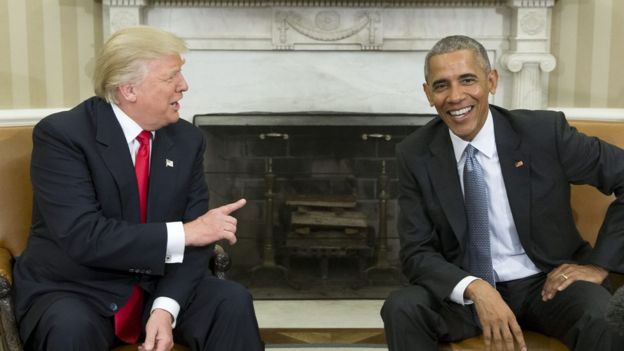
I was so concentrated on not wanting Hillary to become president that I completely disregarded what would happen if the Trumpinator was to be elected. Alas, Trump gave his victorious speech in New York upon winning, Clinton gave her concessional speech and current president Obama is urging a "peaceful transition of power". 
Image result for donald trump and obama

The obvious question is- what happens in America now that all the mind-blowing events have taken 
place? Clearly much is already happening if one is to take into consideration all the riots in, most recognizably, New York. There are now plenty of news reports featuring rioters that chant "Not my president!" in front of Trump Tower as they blatantly ignore their preferred candidate Hillary when she says, "we need to give Trump a chance".  

Although protests are blasted on the media, America's focus should be on the inevitable Trump presidency that awaits our country. Capital Public Radio has researched and written an article on Donald's plan for his first 100 days in office. In Gettysburg Trump spoke about his 100-day plan describing is as "a contract between himself and the American voter" which "begins with restoring honesty, accountability, and change to Washington". 

A few highlights of "Donald Trump's Contract With The American Voter" would include the following:

The cleaning-up of corruption in Washington, DC:

Trump proposes to minimize degeneracy with term limits. McConnel expressed his opposition to this idea stating "I would say we have term limits now — they're called elections." It is interesting, however, that McConnel, being a member of the senate (which does not have term limits) is against this movement.   

Trump also plans to put a freeze of the federal workforce (exempting military, public health, and public safety). A stop on hiring probably will not make the substantial difference to the economy that Trump wants. What would really affect the status quo is complete removal of corrupt departments. 

Another interesting policy he is proposing is "a requirement that for every new federal regulation, two existing regulations must be eliminated" This may work wonders for citizen's liberties and be a minimization of government power assuming Trump can pull it off, only removing unnecessary bans.

Trump also plans to work with congress to introduce several border legislative measures which includes the "Middle-Class Tax Relief And Simplification Act". This is intended to simplify tax reduction by giving the middle class a 35% tax cut. At first glance, this seems impossible for our economy to afford. However, Trump may make this possible through repatriation. 
Repatriation is the process of returning something to its place of origin. The U.S. has trillions of dollars sitting in other countries, unused because it will be taxed if brought back to America. Trump's plan is to get that money back with a minimal tax. What happens then is the company to which the money belongs to invest the cash, hire more employees, and increase production. The whole economy can benefit from this. 

Trump seems to have incredible plans for our country- ones I hope the people and congress will support. Only time will tell whether or not he is capable of fulfilling such promises. For now, we must stand together and accept our new presidential elect who claims "if we follow these steps, we will once more have a government of, by and for the people. Trump is certainly a fighter and i'd love to see him keep fighting with the nation by his side!
Image result for president donald trump


Sunday, November 6, 2016

The Doggerel of Desecration


USA Today announced that on July 2016, seventeen protesters were arrested at a flag burning protest outside the Republican National Convention.  Almost immediately, the topic of flag burning became a hot-button issue with sides advocating flag burning as a form of free speech and others against flag burning as it is disrespectful towards a symbol of the United States.


Allow me to establish a brief timeline of the history of flag desecration. By 1932, the adoption of state flag desecration statutes was implemented by all states. Essentially, this was a flag protection movement which was established to prevent commercial and political misuse of the flag.

These laws prevented citizens from placing any kind of marking on the flag and using the flag in advertising. In these establishments, the flag was also protected from defiance, public mutilating, trampling, defacing, defiling and contempt either by words or by an act.

Several cases of flag desecration were taken to court since then, most of which fell in favor of the defendants. Such cases include but are not limited to Halter v. Nebraska, West Virginia Board of Education v. Barnette and Stromberg v. California. What all the cases had in common was a disregard to what would be considered the established flag desecration restrictions.

It was not until 1989, however, when the most famous case regarding flag desecration took place. Texas v. Johnson, making history as the first time the Supreme Court had directly applied the First Amendment to flag burning, had ruled it unconstitutional to make it a crime to desecrate the flag as a form of free speech.

File:William Kunstler and Gregory Lee Johnson.jpg
(right: Johnson, left: attorney)

The American flag is a symbol of liberty, freedom, and human rights. This is why I almost find it laughably ironic that Gregory Johnson, a Revolutionary Communist Representative, was relieved from prison after setting fire to the flag outside the Republican National Convention in Dallas on account of flag desecration being ruled "symbolic speech". It is painfully paradoxical that Johnson and other protesters chanted "America, the red, white, and blue, we spit on you!" The very fact that protesters have the freedom to dishonor the U.S. flag further illustrates what great liberty it represents. There is something agonizingly poetic about a symbol of freedom being defiled in the act of free choice itself.

Now, 27 years later, protesters stand outside the RNC chanting "five, six, seven, eight, America was never great!" The rioters continue to yell in protest as the flag goes up in flames. To all participants in that rally: America is so prominent in protecting human rights, in fact, that you have the right to informally complain about it.

The objective behind legalizing the desecration of the flag is for citizens to express themselves freely as long as no one is being harmed. In contradiction, almost every record of flag ruination, protesters have been violent, disturbing the peace and assaulting police officers. Are dissidents hiding behind the First Amendment to get away with more violent actions?  Whether it be aggression, derogatory speech or destruction, we the people should recognize that violence is less than ideal and there are more dignified ways to express our beautiful right to speech.

WHY JOHNSON'S ACTIONS WERE NOT IN
VIOLATION OF ANY LAWS?
•

“the Government may not prohibit the expression of an idea sim...

Former Texas Governor Rick Perry eloquently sums up flag desecration saying: "Sometimes, people have some pretty extraordinary ways in which they express their First Amendment right," he said. "That’s not one that I think is particularly thoughtful...Burning something down, whether it’s a flag, whether it’s a home, whether it’s a country, is a poor way to express yourself.”

Thursday, November 3, 2016

Democracy or Idiocracy?

Is America's system of government under trial? Andrew Roberts, a concerned British historian, wrote for the New York Times in his article "1776- would you like to reconsider?" stating that "the American primary system, which has thrown up two presidential candidates who are despised by 60% of Americans, is broken and urgently needs to be reformed." 

How is it that 60% of Americans despise our two choices for president when it is those same citizens who took part in voting for them in the first place? Is this out of impracticality? Dismay? Failures in leadership? Democracy?

The United States is an entertainment-driven nation according to the Nielsen Company which states "more than half the homes in America have three or more TV's". As many of us have come to know, television can be an ineffective way to process news if not analyzed properly. A more shocking statistic comes from the Cable News Network which exclaims "Americans spend an average of $70 billion a year on lottery tickets!" It seems the states have become accustomed thrill, playing the lottery, a game of chance. As a result, oftentimes, we tend to choose exciting over practical. This may be a reason we have wound up with very flamboyant candidates for the presidency. 

Valuable family time


Another reason that our country may have ended up with this 
unique pair could be out of fear of a specific candidate winning the election. "You do not want Hilla the Hun to win- vote Trump!" You would not want pumpkin Hitler to win- vote Hillary!" How many times have you heard, through word of mouth and figuratively every article on the internet, voting for a third party candidate is obsolete?


Are faulty leaders to blame for the less than ideal options we have to choose from or is it democracy itself that is in need of reform? I have stated before in my previous blog "Argument is the Answer" that our way of government is messy, yet liberating. 

China, on the other hand, appears to be doing extremely well in regards to business, investment, and workforce. Coincidentally, China's president Xi Jinping has been elevated to what they call a "core" leader. This does not give Xi Jinping new powers; it does, however, gives him the solitary authority of the Chinese Communist Party. Seeing that Xi Jinping is a dictatorial leader, the concern of him having too much power does arise. 

Xi Jinping earned a  million dollar salary, leaving the net worth at 50 million in 2016

The New York Times shows that a Chinese document proclaims “for a country and for a party, a leading core is vitally important”. The autocratic government of China seems successful for the time being. The downfall of a single concentrated power is shown throughout all of history. Over time, an unchecked, unbalanced leader will become corrupt; not looking out for the interest of their people, but considering only their own interests. 

Are both forms of government not to be trusted? I would say that a democracy is essential for the people to be represented. Ironically, the people are very diverse and each individual has to compromise for any law to pass, any candidate to get chosen and any decision to get made. This is why it is important not to compromise too much by settling on matters or candidates we the people undervalue. 

Friday, October 21, 2016

Safe Spaces Not Safe for Education

The New York Times article "Can Cries of 'Free Speech be a Weapon? Students Say Yes" covers a response to “And Campus for All: Diversity, Inclusion and Freedom of Speech at U.S. Universities"; which includes a plethora of hot-button topics including trigger warnings, microaggressions, safe spaces and controversial campus speakers.
Image result for safe space


The full article, "And Campus for All: Diversity, Inclusion, and Free Speech at U.S. Universities" suggests solutions vouching for limits of  speech that could make students feel 'unsafe'. PEN, an organization which declares its purpose is to "promote literature and defend freedom of expression worldwide" claims to be a 'marketplace of ideas' and a 'guardian of intellectual integrity' yet it is pushing to restrict speakers off campuses that offer novelty into the shallow pool of mainstream media.

The First Amendment guarantees freedom of speech, freedom of the press, freedom of petitioning the government, freedom of assembly and freedom of religion. However, throughout the nation's history, the Supreme Court has ruled that these rights may be limited in the interest of the greater public good. 

Some restrictions on speech are understandable, necessary and constitutional. Scenarios in which free speech may be limited is when it is has a tendency to lead to illegal action, is lewd or indecent or evokes a danger which is false. This form of speech would be unlawful and potentially dangerous. 

This is when the very definition of "dangerous" is changed to accommodate those who are easily offended. Millennials, facing no real harm when a speaker would oppose their worldview, will redefine "unlawful". Students are now announcing that what they would consider an 'intolerant' speaker, hurtful when, in reality, the only thing getting hurt is their feelings. There is a fine line between potential harm and emotional disturbance just as there is a difference between a 'safe space' and a therapy session. 

The students addressed in the article above are in opposition to speech that would be considered intolerant or that would not affirm to everyone on campus. In essence, they are claiming to promote "inclusiveness and diversity" when, in reality, their intentions are to reestablish free speech rights as wrong unless these 'rights' are in total conform to their way of thinking.Image result for safe space

Permitting what the majority considers 'non-offensive' speakers exclusively is not only an unconstitutional restriction on free speech, but also a limitation on education itself which requires conflict to thrive. Education, by definition of dictionary.com, is the process of "developing the powers of reasoning and judgment, and generally of preparing oneself or others intellectually for mature life." How, then, can these young adults strengthen their preparedness for a mature lifestyle when they are encouraged to sit in a padded room with puppies having heard anything they have been 'triggered' by.

This new form of 'free speech' only applies to those with the majority of the power for the time being and downsizes anyone who wishes to speak against the status quo. These Millennials are quite frankly, as Albert Molar put it, "in the name of inclusiveness and diversity (shutting) down exclusiveness and diversity, a diversity of opinions."
Image result for safe space

Friday, September 30, 2016

Argument is the Answer


Over the years, my eyes have been opened to increasing numbers of people who think negatively of debates. In fact, many characters I have come to know discourage controversy and, by default, critical thought. They tend to believe debating serves no purpose; always ending in both parties leaving with their opinions unchanged.

Related image

In Joseph J. Ellis's novel American Creation-Triumphs and Tragedies at the Founding of the Republic chapter three, he summarizes the authorization of our ever-compromising government.

After the Revolutionary War, George Washington, and his soldiers finally freed the colonies from the tyranny of Britain. Although Washington's men prompted him towards becoming the new nation's leader, he chastised them. He refused to repeat history by crowning himself king of the infant nation. However, being under the Articles of the Confederation during the battle, George understood all the shortcomings of them and saw they would not be fit for a successful nation, either.

The Articles of the Confederation, which is the first government of the newly born United States of America, was formed under the Constitutional Convention and informally followed from 1776 to 1781. The Constitutional Convention was a meeting of political pragmatists that knew protecting everyone's property and rights mean they can also secure their own.

Under the Articles of the Confederation, each state had its own central government. For the states, this posed many weaknesses. A decline in international ensued and the value of money dropped since each state printed its own currency. The threat of social disorder and foreign enemy attacks skyrocketed. The deficiency of the Articles became too much when the state of Massachusetts could not effectively deal with Shay's Rebellion. Joseph Ellis describes this as " a six-month rebellion in which more than 1,000 armed farmers attacked federal arsenal to protest the foreclosure of (their) farms".

Image result for shays rebellion

The Articles of the Confederation, although liberating, left the 
federal government without enough power to properly govern the states. Under the articles, the federal government could not draft soldiers or tax citizens. Therefore, it could not pay off the Revolutionary War debt and had no national currency. It was around this time in which both Washington and Madison came to the conclusion that the Articles of Confederation needed to be replaced with a national government that possessed a clear mandate to equip the states in both foreign and domestic policy.


The first ten months of the Constitutional Convention is a period of time which Joseph Ellis describes as "the most far-ranging and consequential political debate in American history". In this moment of time, two primary parties in the great debate were assembled. The federalists, those who wanted to ratify a constitution consisting of guidelines for a strong central government and the anti-federalists, those opposed to what they perceived as a reestablishment of the oppression they have just been liberated from.

Image result for the revolutionary war

Federalists had the goal of establishing a system of government 
under which the national government and state governments share powers (federalism). The idea of an institutionalized Constitution is to have a unique form of shared sovereignty and division of power. Under federalism, delegated, expressed, or enumerated powers could print  money, regulate interstate and international trade, make treaties concerning foreign policy and declare war. Secondly, reserved powers could issue licenses and run federal elections. Finally, concurrent powers were permitted to collect taxes, build roads and operate courts of law.

On the other hand, anti-federalists were in disagreement with any form of government; believing them to be far removed from the citizens it would ostensibly represent. The anti-federalists, afraid to fall under yet another oppressive rule, anchored themselves in the revolutionary ideology that regarded any powerful central government as a domestic version of the British government they had been previously freed of.

James Madison proclaimed the chief goal of the federalists was to offer a Constitution that would be a rescue rather than a betrayal of the principles of the American Revolution. Madison was so intelligent that if he worked diligently, he had the ability to convince the people.

Patrick Henry argued that he, along with the rest of the anti-federalists, were protecting Americans from a hostile takeover by an elite minority. Henry was an incredibly persuasive speaker. In fact, he was so prominent that Jefferson joked to Madison the only thing he could do when confronted by Henry is "devoutly pray for his imminent death". 

After the Henry-Madison debate finally concluded, the people concurred a new form of bureaucracy was needed. The Constitution was then sent to each individual state for ratification. 

Related image

The Constitution was established through a messy progress of 
compromise and debate that still continues to this day. Even when it may seem that bedlam ensues through this process, it is imperative to remember that a prosperous nation would be inconceivable without it. Seemingly tedious arguing is, in reality, the very foundation of America. 

In light of the groundwork of this great nation, don't groan at the next dispute you hear. Instead, remember that controversy is not about providing answers, but rather about providing a framework in which unanswered questions can be further discussed.

Tuesday, September 27, 2016

Swampy Shenanigans

The Clinton-Trump presidential candidate debate aired on CNN December 26, 2016, sparking the interest of Americans and others worldwide. The first presidential debate featured the only female presidential candidate who has made it this far-Hillary Clinton- and business a man who has previously not involved in politics-Donald Trump. Let us not forget Lester Holt, who may have played a little more than his part as host of this event.


Image result for lester holt debate

I have noticed that many Americans do not prefer either candidate featured in this debate. This is when I started to ask myself how each nominee made it to where they are at. Hillary, being wedged in the political system for 30-some years now, appears to have the upper hand in swaying voters and pleasing crowds. She was a possible choice in the 2008 election and the 67th U.S. secretary of state. Clinton gathered much publicity through her positions and simply being a woman. Her policies ostensibly do not call for an immense change in the United State's status quo.

Image result for trump clinton debate

Trump's political background, or lack thereof, greatly contrasts Hillary's experience. Donald's 2016 presidential campaign is his first time personally running for a political position. Any other bureaucratic participation he may have branches from his involvement as a business man and citizen. Any viewer will find it nearly impossible to dismiss Trump's flamboyancy. He has accumulated popularity by means of his colorful personality and his passionate need to shake the state of affairs in America's economy.

Why are both options are seen as undesirable to the people? "Crooked Hillary" earned her nickname by carrying out the role of a dishonest politician willing to try anything to make it in the big leagues. Citizens are discovering her willingness to change policies and be a lenient are part of a ploy to please the undecided voters. Whereas Trump is presented as a man who firmly stands on his policies and ideas that will "make America great again". His unwillingness to budge on, for example, foreign policies and unpracticed skills on political correctness oftentimes leave Donald looking like a raging toddler.

Each successor, seemingly pedantic, made it this far for a reason. They are both very animated figures in government and did well hanging on the rickety roller-coaster of democracy long enough to ride up to the first presidential candidate debate. People seem fed up with the heated arguments of these two and often in the process forget that a nation without debates is not free. The American republic is open to messy, abstruse, discussions because we have liberty.

Who is the better choice? Essentially, it boils down to keeping the status quo or drastically changing it.

Picture America as the stagnant water in a swamp. Algae is continually collecting on this water. This water has been dirty for a while now and people are afraid to disturb it in fear that new problems will arise in removing the grime in the swamp. There are legitimate reasons for not wanting to change the water. After all, there could be unseen epidemics that could occur from changing the ecosystem of the marsh. However, the people are disgusted with swimming in the contaminated swamp and will not stand for it any longer.


Image result for trump this is my swamp

United States citizens are fed up with the tired political policies of politicians that fail to better our economy. America is hungry for change.